Adaptive Racket Gauntlet
The problem
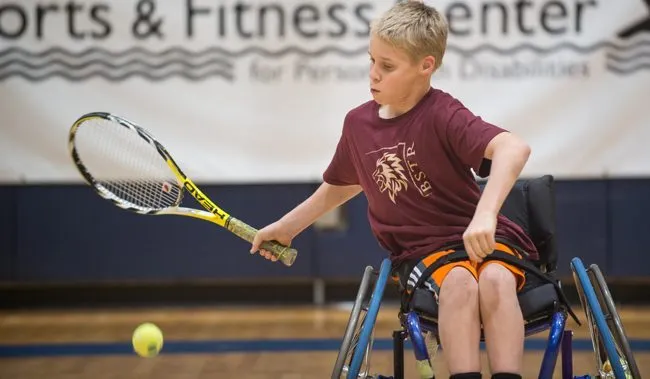
Our client works with low-mobility students in adaptive physical education who often struggle to simultaneously grasp an object, control its movement, and accurately aim it toward a target. These combined motor demands create real barriers to participation in racket-based sports — and to the coordination, endurance, and social development that come with them.
We learned we needed to find the problem before we could solve it — the client search was its own design constraint.
Sourcing the project from scratch
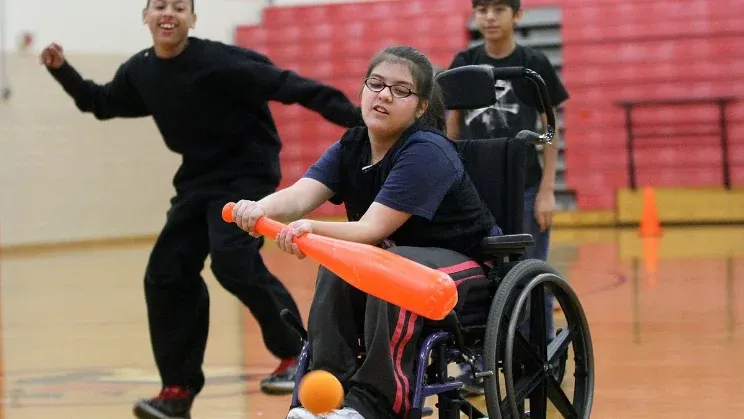
Our course required each team to identify and secure its own client rather than pick from an assigned list. I led that outreach: cold-emailing adaptive PE and special-education programs across the district, following up with phone calls, and pitching the team’s design capabilities before a problem was even defined. Sarah Brockberg at D49 Adapted PE responded, and I ran the intake conversations that turned her day-to-day classroom frustration into a scoped engineering problem.
Students should not have to adapt to existing equipment, the equipment should adapt to the student.
Prototype v1 — forearm gauntlet
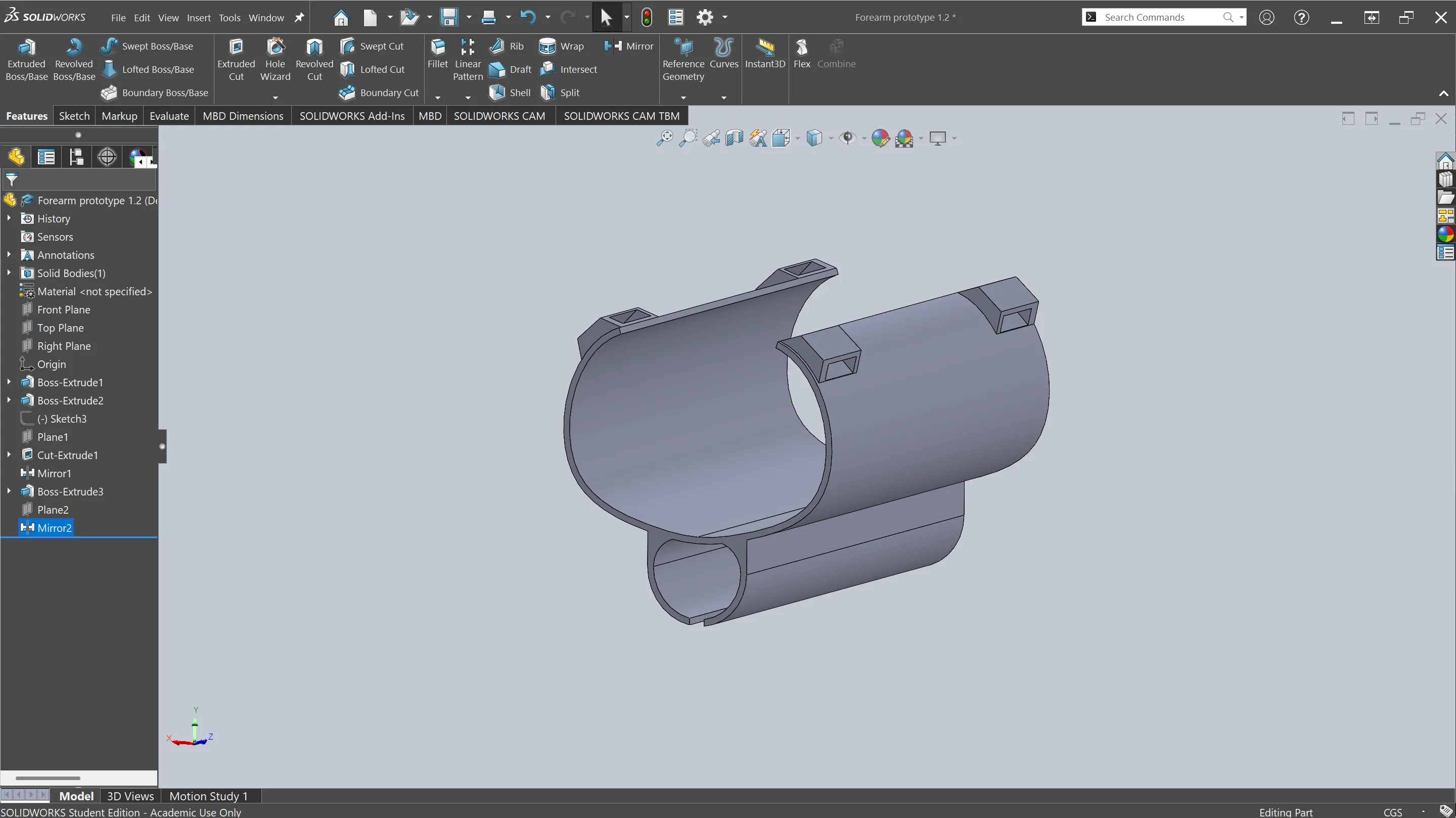
Modeled after AFO (ankle-foot orthosis) bracing principles, the gauntlet is a rigid forearm shell that mounts the racket to the limb instead of the hand, removing grip from the equation entirely. Sarah, our APE-teacher client, confirmed this eliminated the single biggest barrier for her students: many have limited or no active hand function.
Testing and client feedback revealed an ergonomic issue. The wrist was bent back, and dorsiflexion is not a viable resting position for the majority of Sarah’s students.
MVP field test
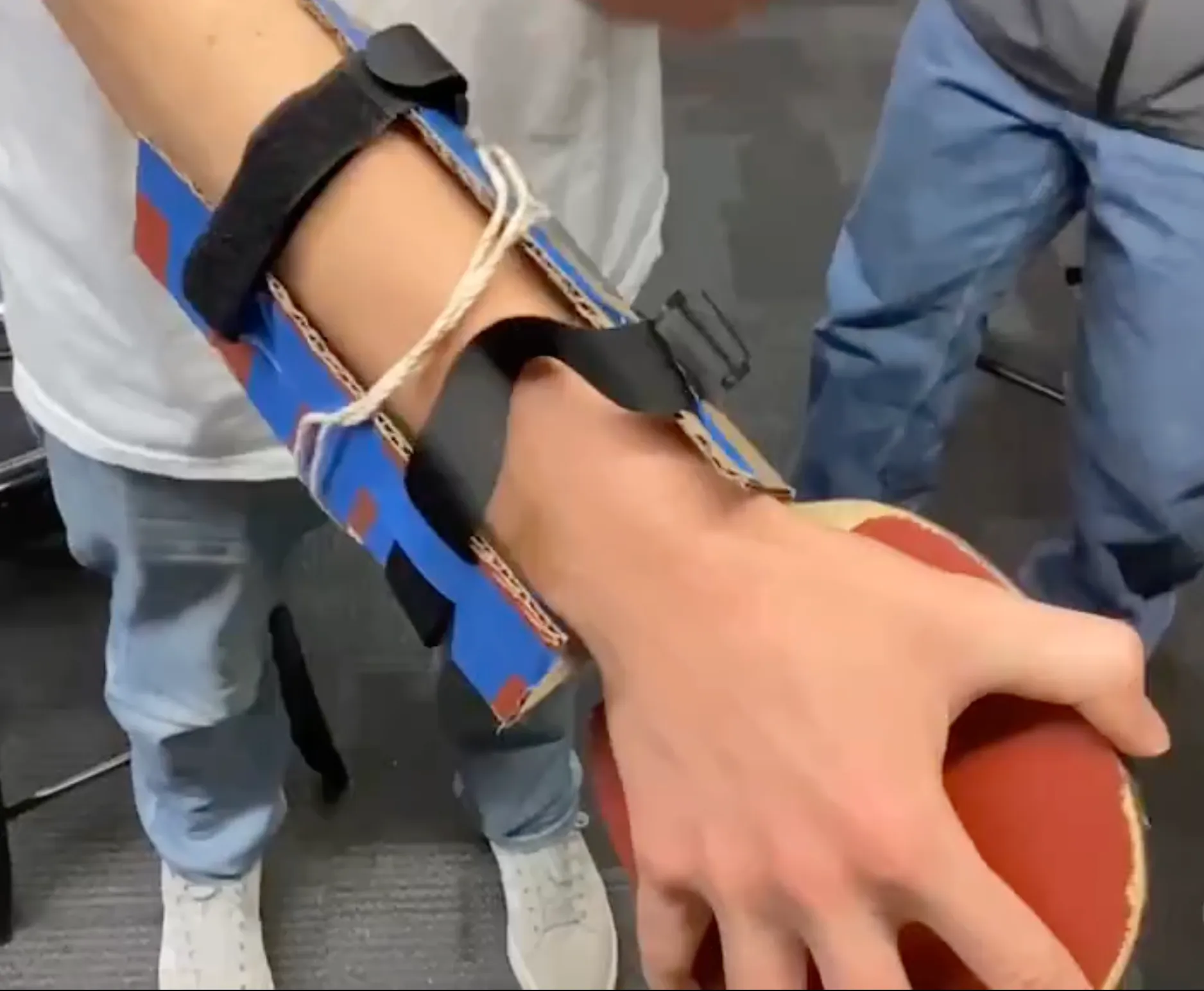
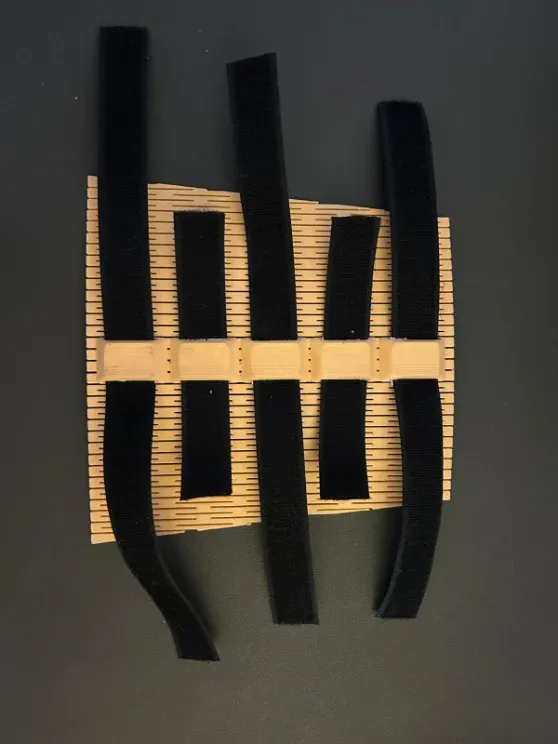
Redesigned around a neutral wrist position, the MVP introduced two parallel attachments. A fabric mitten and PLA plate, and the redesigned gauntlet attachment connected to the racket via a box-and-slot system cinched with hook and loop fabric. Twenty minutes of live badminton play, including serves and overhead strikes, validated the mechanical interface with zero rotational slippage on the gauntlet.
Roadmap: iteration 2.0
Testing surfaced a second pain point beyond grip: comfort. Rigid PLA geometry pinched at the wrist and elbow, and dense internal print supports created a 30-minute post-processing bottleneck per unit. The next iteration targets manufacturing optimization, joint clearance, and a universal ergonomic pass across both the mitten and plate variants.
Further testing showed the fabric mitten was never load-bearing or necessary as the gauntlet alone held the racket with zero slippage.
Iteration 3.0 — one-way flexible mesh
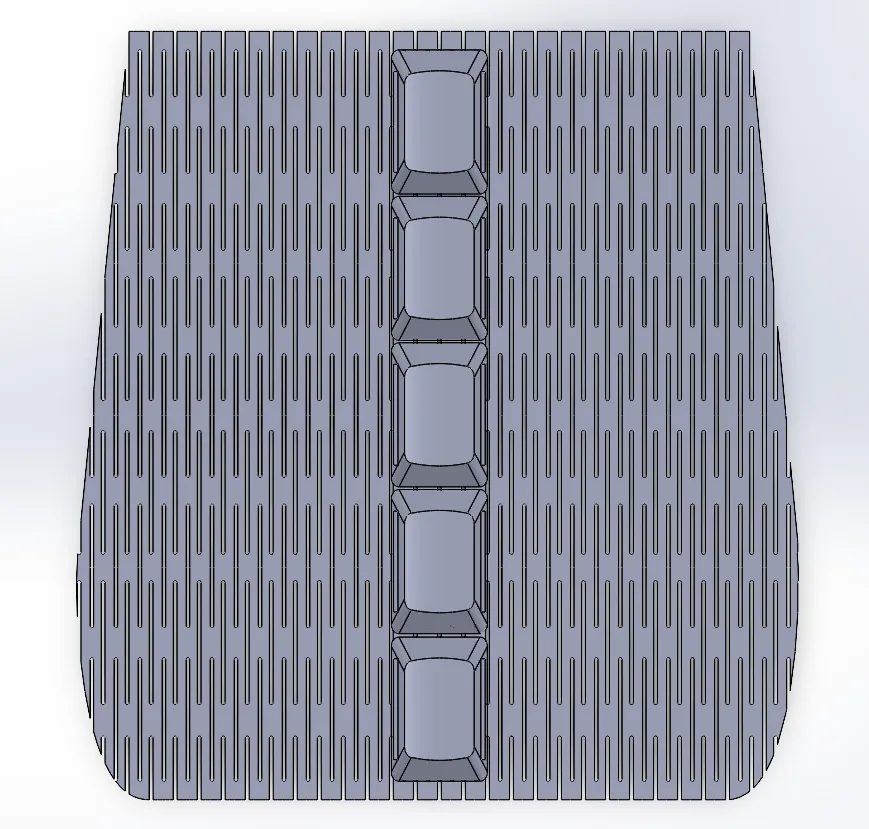
To solve the comfort problem without giving up rigidity where it mattered, we redesigned the shell around a one-way flexible PLA mesh: a print pattern that lets the gauntlet flex at the wrist and elbow along one axis while staying stiff against the racket’s torque loads. It eliminated the pinch points and the 30-minute support-removal steps and made the print faster and simpler. Now anyone with a 3D printer can go to our website and print the gauntlet themselves, for free.
Performance data
| Metric | Target | Actual | Status |
|---|---|---|---|
| Total weight | < 1.0 lb | ~0.25 lb | Validated |
| Production cost | < $5.00 | ~$3.15 | Validated |
| Grip dependency | 0% active grip | 0% active grip | Validated |
| Assembly effort | Low effort | ~5 min/unit | Validated |